You slept five hours last night. Maybe six. You powered through the day on caffeine and adrenaline, and you'll probably do it again tomorrow. What you don't know is that while you were grinding, your brain was losing something it can't easily get back.
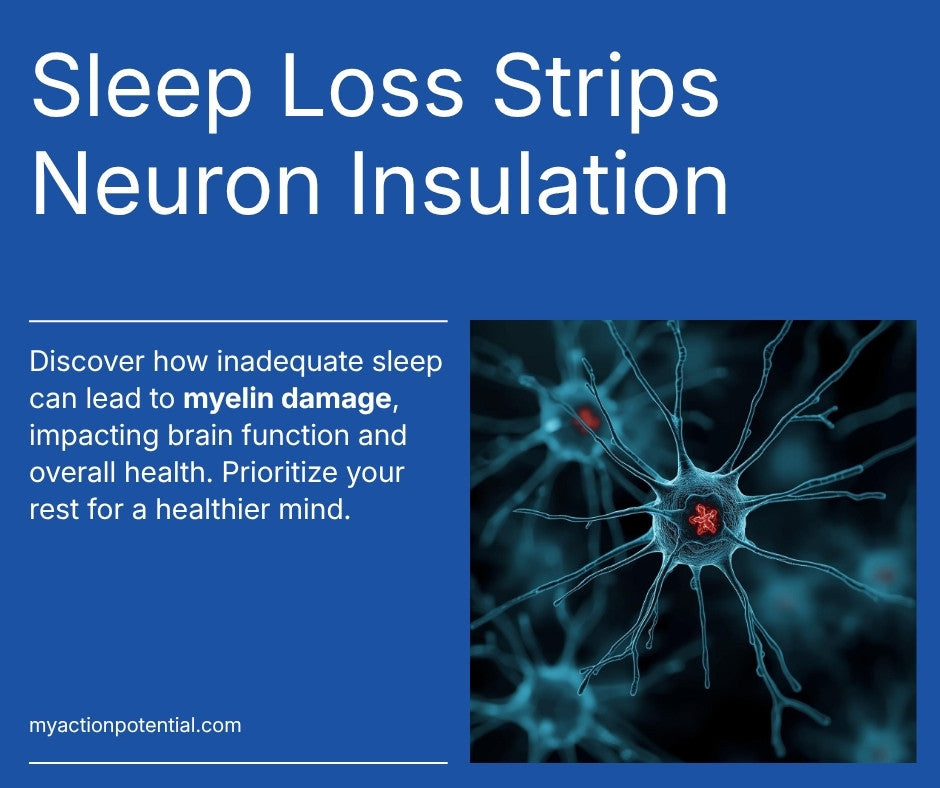
A study published in early 2026 in PNAS found that sleep deprivation physically thins the myelin sheath, the fatty insulation wrapped around your neurons' axons. In sleep-deprived rats, researchers measured thinner myelin compared to well-rested controls, and signaling between brain regions slowed by roughly a third. That's not a subtle dip. That's your brain running on a bad connection.
What myelin actually does
Myelin is the white matter of your brain. Oligodendrocytes produce it: a lipid-rich layer that wraps around the long fibers (axons) carrying electrical signals between neurons. Without it, signals scatter and slow. Picture the rubber coating on an electrical wire. Strip it off and current still flows, but it leaks, shorts out, and takes longer to arrive.
People with demyelinating conditions like multiple sclerosis experience dramatic cognitive and physical symptoms for exactly this reason. The wiring is intact. The insulation isn't.
What the 2026 PNAS study showed is that you don't need a disease to lose myelin. You just need to stop sleeping.
The brain doesn't rest during sleep. It repairs.
Sleep isn't downtime. During deep slow-wave sleep, the glymphatic system flushes metabolic waste from brain tissue. Cerebrospinal fluid moves through channels between cells and clears out beta-amyloid, tau proteins, and other debris that pile up during waking hours. Oligodendrocytes are most active during this window, too, producing new myelin and repairing damaged segments while you're unconscious.
Cut that window short and the repair doesn't happen. The waste doesn't clear. The insulation gets thinner.
Earlier research from the University of Pennsylvania had already shown that extended sleep loss kills locus coeruleus neurons, the brain cells that handle alertness and attention. Those neurons don't come back. A separate line of research identified a protein called pleiotrophin (PTN) that normally protects hippocampal neurons during sleep deprivation. When PTN levels drop, hippocampal cells start dying. The hippocampus is where memories are formed. You don't want to lose cells there.
Sleep loss and your brain's chemistry
Myelin damage is structural, but sleep loss also wrecks your neurochemistry. Dopamine receptors become less sensitive after one bad night. Serotonin production drops. Cortisol rises and stays elevated, and that triggers neuroinflammation, a slow burn of immune activity in the brain that damages neurons over time.
This is why poor sleepers report brain fog, irritability, trouble concentrating, and emotional swings. Their neurotransmitter systems are running on empty because the brain never got the time it needed to restock.
We wrote about how a single mineral can make aging brains function years younger, and that mineral was magnesium, which also happens to be one of the most effective natural sleep aids. Brain health and sleep health run on the same hardware.
What you can do about it
I'm not going to lecture you about eight hours. You've heard it. Here's what you might not have heard.
Magnesium glycinate before bed calms the nervous system by activating GABA receptors, the same pathway that benzodiazepines target, but without the dependency risk. Most Americans are magnesium deficient, and the deficit hits the brain hardest. Our Magnesium Glycinate uses the glycinate form because it crosses the blood-brain barrier more effectively than oxide or citrate.
Your body makes melatonin from serotonin, and serotonin from the amino acid 5-hydroxytryptophan. If that pathway is depleted from stress, poor diet, or chronic sleep disruption, supplementing with 5-HTP can help the brain rebuild its sleep-wake signaling.
Research on Hericium erinaceus (lion's mane mushroom) shows it stimulates nerve growth factor (NGF) production, which supports oligodendrocyte function, the same cells that build and repair myelin. We covered the broader brain benefits in our article on Lion's Mane Mushroom Extract and brain health. Our Lion's Mane Mushroom is extracted for potency rather than ground whole because the bioactive compounds (hericenones and erinacines) are what matter.
Ashwagandha has over a dozen randomized controlled trials showing reductions in serum cortisol. Less cortisol means less neuroinflammation, better sleep onset, and a brain that can actually do its nightly repair work. Our Ashwagandha uses KSM-66, the most clinically studied extract available.
The research backing targeted nutritional support for brain health is large. We've compiled over 400 peer-reviewed studies on our Evidence page.
The bottom line
Your brain can handle one bad night. Maybe two. But chronic short sleep, the kind most working adults have accepted as normal, is doing structural damage: thinner myelin, dead neurons, depleted neurotransmitters. These aren't hypothetical risks. They're measured, published, replicated findings.
Sleep is when your brain rebuilds itself. Skip it, and you're skipping the only repair window your neurons get.
These statements have not been evaluated by the Food and Drug Administration. These products are not intended to diagnose, treat, cure, or prevent any disease. Always consult your healthcare provider before starting any supplement regimen.
Frequently asked questions
Can lost sleep cause permanent brain damage?
Animal studies suggest it can. Research from the University of Pennsylvania showed that extended sleep deprivation caused irreversible loss of locus coeruleus neurons. The 2026 PNAS study showed myelin thinning, though researchers are still studying whether myelin fully recovers once sleep is restored.
How much sleep do I need to protect my brain?
Most adults need seven to nine hours. What matters more than total hours is sleep quality, specifically time spent in deep slow-wave sleep, which is when myelin repair and glymphatic clearance happen.
Does magnesium really help with sleep?
Multiple clinical trials show magnesium glycinate improves sleep onset latency and sleep quality, especially in people who are deficient. About half of American adults don't meet the recommended daily intake.
What does lion's mane have to do with sleep?
Lion's mane supports nerve growth factor production, which helps oligodendrocytes, the cells that produce myelin. It doesn't directly induce sleep, but it supports the cellular machinery your brain uses during sleep to repair myelin.
Is the brain damage from sleep loss reversible?
Some of it appears to be. Myelin can be rebuilt by oligodendrocytes when sleep is restored. But neuron death in the locus coeruleus and hippocampus appears permanent in animal models. The takeaway: don't wait to find out which category you fall into.
Hero image created with AI-assisted design tools.